
Comparative Analysis of Three Feeding Structures for Copper‑Aluminum Busbar Bending Machine: Selection Reference for Track‑Type, Roller‑Type and Clamping‑Type
In the production of new‑energy equipment, electrical cabinets and energy‑storage devices, the feeding structure of a copper‑aluminum busbar bending machine directly determines busbar machining accuracy, yield rate and production efficiency. Three mainstream feeding systems are widely used: track‑type, multi‑set roller‑type and clamping‑type feeding. Each structure differs greatly in insulating‑material compatibility, processing scenarios and operation‑maintenance costs.
Improper feeding‑structure selection frequently causes common production issues, including material scratches, feeding deviation, frequent part replacement and insufficient throughput. This article objectively compares performance, advantages, drawbacks and applicable scenarios of the three feeding structures, to help manufacturers match equipment with actual production requirements.
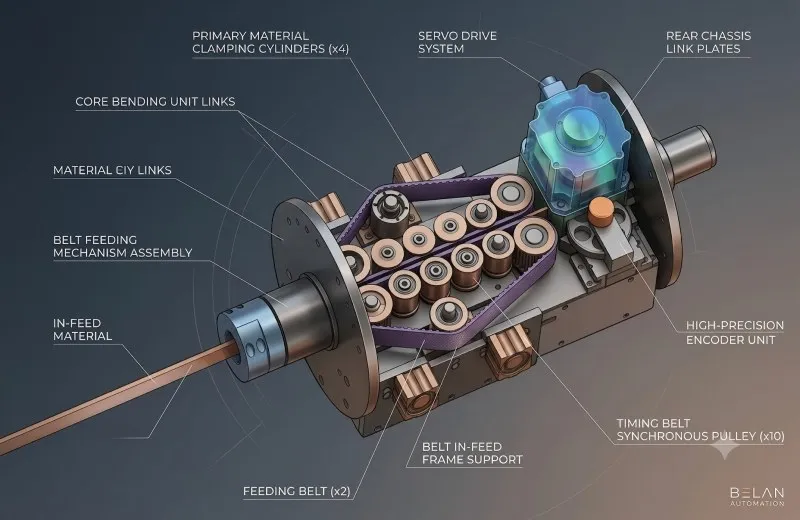
Overview of Mainstream Busbar Feeding Structures
Currently, three typical busbar feeding mechanism solutions dominate the market: track‑type feeding adopted by BELAN machines, 8‑set roller feeding widely used by other brands, and clamping‑type feeding installed on partial equipment models.
Due to different mechanical principles, these structures deliver varied compatibility, machining stability and maintenance costs for PA12‑insulated and PVC‑mica‑clad busbars. None of them is universally superior, and suitability mainly depends on practical working conditions.
Detailed Comparison of Three Feeding Structures
1. Track‑Type Feeding (Standard for BELAN copper‑aluminum busbar bending machine)
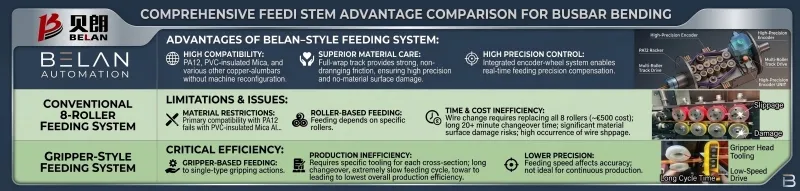
As a highly‑adaptable new‑generation feeding design, track‑type feeding features a full‑enclosure contact structure and supports most busbar materials on the market. It is fully compatible with PA12‑insulated aluminum busbars and PVC‑mica‑clad copper‑aluminum busbars, breaking the single‑material limitation of traditional busbar processing equipment.
The large wrapping contact surface increases friction evenly, ensuring stable feeding without scratching or squeezing the insulating layer or metal substrate. It effectively avoids material slippage and offset, and greatly cuts down the frequency of spare‑part replacement. Equipped with an encoder‑wheel precision compensation system, the machine corrects feeding deviation in real‑time, improves dimensional consistency of finished bend parts and raises product yield without secondary trimming.
Its primary disadvantage is slightly higher initial procurement cost compared with roller‑type and clamping‑type systems. For small‑scale manufacturers processing only one single material with low‑volume orders, its cost‑performance advantage is not prominent enough.
2. 8‑Set Roller Feeding (Common Structure for Other Brands)
8‑set roller feeding is a mature traditional solution with low manufacturing cost, once widely used on early‑generation busbar benders. Its major limitation is narrow material compatibility. It works steadily for PA12‑coated busbars, yet frequently causes insulation wrinkling, asynchronous movement and material offset on PVC‑mica workpieces.
Operators have to replace the whole set of eight feeding rollers when switching to different busbar sizes. One roller kit costs around 4000 currency units and the replacement process takes roughly 20 minutes, bringing extra spare‑part expenses and production downtime. Point‑pressure contact from rollers also raises risks of surface scratches and defective parts.
Its strengths lie in simple mechanical layout, low failure rate and convenient maintenance. It can satisfy basic production demands for long‑term fixed‑spec PA12 busbar processing.
3. Clamping‑Type Feeding (Adopted by Partial Third‑Party Machines)
Clamping feeding is a customized feeding scheme with polarized material adaptability. It performs stably for PVC‑mica busbars, while its processing efficiency drops sharply for PA12‑coated workpieces, making it unsuitable for multi‑material production lines.
This mechanism rarely requires frequent roller or fixture replacement, resulting in relatively low consumable‑part expenses and good structural durability. However, its intermittent reciprocating feeding cycle limits operating speed. The overall throughput is far lower than continuous‑running track‑type and roller‑type systems. It is mostly recommended for low‑volume customized production of PVC‑mica busbars, instead of high‑capacity mass‑production lines.
Selection Guide For Different Working Scenarios
Combined with the cost and performance characteristics above, manufacturers can follow the principles below:
- Choose track‑type feeding: multi‑material mixed processing, high‑precision & zero‑scratch requirement, mass continuous‑production
- Choose 8‑set roller feeding: fixed PA12 material only, limited budget, priority for low failure rate
- Choose clamping‑type feeding: exclusive PVC‑mica busbar production, small‑batch custom orders, low consumable‑cost priority
Final Summary & Equipment Consultation
There is no one‑size‑fits‑all busbar feeding mechanism. Improper feeding‑system selection will raise spare‑part costs, waste working hours and negatively affect machining accuracy and delivery schedules.
BELAN Machinery delivers professional metal‑forming processing solutions. If you are unsure which feeding configuration suits your raw materials, or need tailored machine parameters, layout plans and quotations according to production capacity and product range, please feel free to contact us. We will provide one‑on‑one equipment recommendations fully matched to your actual production conditions.
For detailed specifications or equipment quotation, please reach out to our sales team.
 +86-18098256570
  Email
Email

