
In today’s manufacturing industry, a wire bending machine plays a crucial role in shaping various metal products. From automotive parts and supermarket racks to kitchen hardware and lighting frames, a reliable wire bending machine can dramatically improve production efficiency and product consistency.
However, with so many models available on the market — 2D or 3D, single-head or dual-head, mechanical or fully CNC-controlled — choosing the right machine can be challenging. This guide will walk you through the key factors to consider before purchasing a wire bending machine.
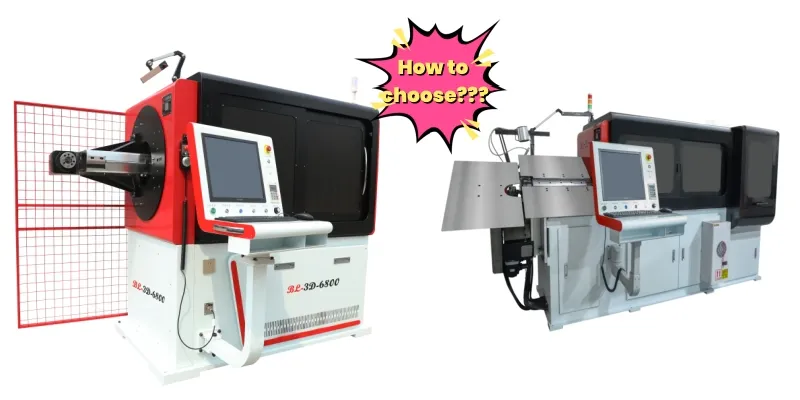
1. Define Your Wire Diameter Range and Product Type
The first step is to clearly identify the wire diameter you need to process. Generally:
- Small diameter (0.8–2.0mm): Suitable for electronic springs and craft items.
- Medium diameter (2.0–6.0mm): Ideal for daily hardware or automotive accessories.
- Large diameter (6.0–16mm+): Used for heavy-duty structural parts and frames.
Your chosen wire size determines the torque, servo motor power, and bending head design — which directly affect the machine’s stability and service life.
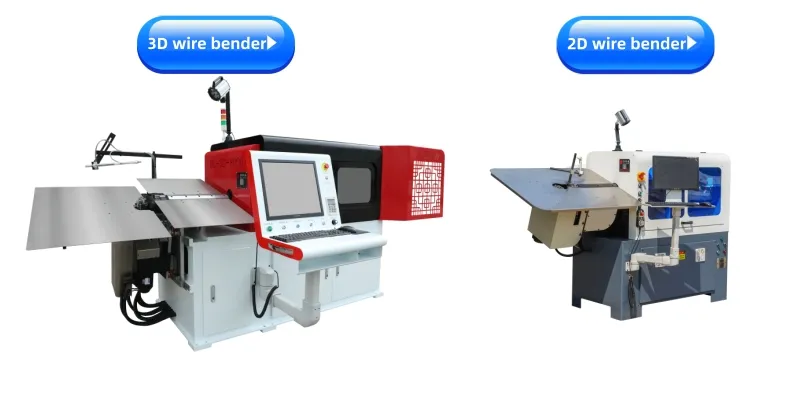
2. Choose Between 2D and 3D Wire Bending Machines
A 2D wire bending machine is perfect for flat products such as racks, baskets, and hooks. In contrast, a 3D wire bending machine can form complex three-dimensional shapes, commonly used in car seat frames, lighting supports, and industrial components.
If your products vary frequently or require multi-angle bending, a 3D CNC bending machine with automatic programming and simulation will greatly reduce setup time and improve precision.
3. Evaluate the Control System and Software Capabilities
The control system is the brain of any CNC bending machine. A high-quality system should provide:
- Automatic collision avoidance and simulation functions;
- Precision servo control with repeatability of ±0.1mm.
Advanced systems also support remote monitoring, data storage, and cloud-based updates, making your production smarter and more efficient.
4. Inspect the Machine Structure and Bending Accuracy
Machine rigidity directly influences bending precision and long-term reliability. Key aspects to check include:
- Dual-wheel synchronized wire feeding system;
- All-steel or alloy bending head construction;
- Automatic straightening and cutting functionality.
5. Consider After-Sales Service and Spare Parts Support
Buying a machine is just the beginning. Reliable after-sales service ensures continuous operation and lower downtime. Ask the supplier about:
- Remote technical support and on-site training;
- Availability of key spare parts and quick replacement service;
- Software upgrade and parameter backup options.
For international users, check whether the manufacturer provides CE or MD certification to ensure compliance with European market standards.
6. The Ideal Formula for Selecting a Wire Bending Machine
Selection Formula: Wire Diameter Range + Product Design + Control System + After-Sales Support = Ideal Wire Bending Machine
Within your budget, always choose a machine with high precision, strong stability, and comprehensive service. This will help your production line achieve long-term efficiency and consistent quality.
7. Recommended Brand Example
Belan Automation offers a full range of 2D and 3D CNC wire bending machines, covering wire diameters from 3mm to 16mm. The company’s self-developed control system, stable mechanical structure, and CE-certified products make it a trusted supplier for industries including automotive, furniture, and construction hardware.
Choosing the right wire bending machine is the first step toward smarter and more efficient manufacturing.
 +86-18098256570
  Email
Email

