
Complete Guide for Busbar Bending Machine: Principle, Selection, Application and Advantages for EV Busbar Manufacturing
1. WHAT IS A Busbar Bending Machine
The Busbar Bending Machine is dedicated core‑level machinery for EV busbar fabrication. It delivers precise bending and forming for copper, aluminium and insulated coated busbars, catering to complicated wiring requirements of EV batteries and electric‑control assemblies.
Modern‑day CNC Busbar Bending Machine runs full‑automatic production via servo‑driven control systems. It fixes common defects of manual bending, including poor precision, workpiece spring‑back and low throughput. Custom‑optimized for thin‑gauge EV conductive strips, the machine handles multi‑angle and irregular‑shaped busbar forming.
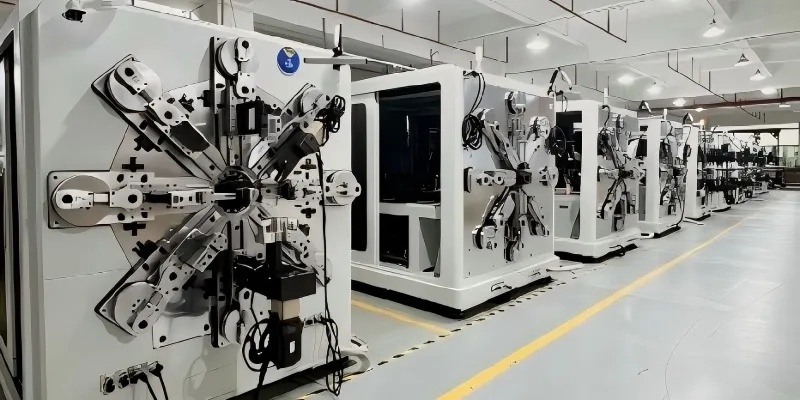
2. WORKING PRINCIPLE OF EV‑SPECIFIC Busbar Bending Machine
Mainstream EV‑grade Busbar Bending Machine adopts full‑servo closed‑loop control. Servo motors and precision lead‑screw assemblies regulate bending stroke, angle and pressure and eliminate oil‑pressure deviation from old‑fashioned hydraulic devices.
Full‑automatic Machining Process
Operators input processing parameters into the CNC controller. The machine automatically finishes feeding, straightening, positioning, bending, cutting and resetting. It supports L‑shape, U‑shape, Z‑shape, flat‑bend, edge‑bend and torsion 3‑D forming. Bending‑angle tolerance reaches ±0.1°, and dimensional error stays below 0.01mm.
Adjustable bending torque for coated busbars stops insulation cracking and material rebound to satisfy strict NEV manufacturing criteria.
3. MAIN APPLICATION SCENARIOS
Busbars serve as vital conductive components for power batteries, vehicle controllers and charging piles. Machining accuracy determines the whole‑vehicle electrical stability, and the Busbar Bending Machine has been widely used across the new‑energy industrial chain.
3.1 NEV Power Battery
Fabricate internal copper‑aluminium connecting busbars and high‑voltage integrated conductors for battery modules, meeting compact‑size, high‑precision and consistent forming standards.
3.2 On‑board High‑voltage & Electric‑control System
Produce custom‑shaped busbars for motor controllers, high‑voltage distribution boxes and control units, adapting to complex circuit layouts and avoiding assembly collision.
3.3 Charging Piles & Energy‑storage Cabinets
Process heavy‑current busbars for energy‑storage equipment and AC‑DC charging stations, delivering stable performance for large‑scale standardized batch‑production.
4. KEY SELECTION GUIDELINES FOR Busbar Processing Machine
For EV busbar production, manufacturers shall prioritize precision, production flexibility and material compatibility, rather than blindly chasing high power output.
4.1 Machining Precision & Stability
Pick full‑servo CNC Busbar Bending Machine to guarantee bending‑angle and repeated‑positioning accuracy and eliminate dimensional deviation and spring‑back defects in mass‑production.
4.2 Multi‑material Compatibility
The machine shall handle thin copper strips, aluminium bars and plastic‑coated busbars. Multi‑specification irregular bending adapts to multi‑variety small‑batch NEV manufacturing modes.
4.3 Automation Level & Maintenance Cost
Choose intelligent CNC‑controlled machinery supporting one‑click parameter recall and fast product change‑over, lowering manual debugging workload and long‑term operating expenses.
5. CORE MERITS OF EV‑DEDICATED CNC Busbar Bending Machine
- Higher machining precision. Closed‑loop servo control ensures outstanding finished‑part consistency and cuts scrap and re‑work rates.
- Premium forming quality. Custom moulds and adjustable bending torque deliver scratch‑free bending and intact insulation for coated busbars.
- Higher production yield. Automated workflow and rapid‑change‑over lift output by over 40 % compared with conventional bending gear.
- Broad‑range compatibility. One‑set Busbar Processing Machine covers most EV busbar specifications and saves equipment procurement costs.
6. FREQUENTLY‑ASKED QUESTIONS
Can Busbar Bending Machine process insulated copper and aluminium busbars?
Yes. EV‑optimized bending equipment adjusts contact structure and bending pressure to protect the outer insulating coating.
Is the CNC Busbar Bending Machine suitable for small‑batch custom‑made parts?
Perfectly suited. Saved process parameters enable quick switch‑over without frequent mould debugging.
What precision standard applies to EV high‑voltage busbar bending?
Industrial benchmark permits maximum angle deviation ±0.1° and dimensional tolerance ≤0.01mm for safe assembly and power transmission.
SUMMARY & CUSTOMIZED EQUIPMENT SOLUTION
Against the trend of intelligent, high‑precision new‑energy vehicles, the professional Busbar Bending Machine acts as core production hardware for EV conductive components. Mastering machine principles, selection criteria and application scenarios helps factories resolve processing bottlenecks and achieve automated premium‑grade busbar manufacturing.
BELAN Automation specializes in automotive metal wire‑forming machinery. Reach out to our technical team if you require high‑precision, fully‑automatic CNC Busbar Bending Machine and Busbar Processing Machine. We supply tailored proposals, machine specifications and free sample‑testing service to upgrade your automated busbar production workflow.
For more information or to schedule a demo, please contact our sales team.
 +86-18098256570
  Email
Email

